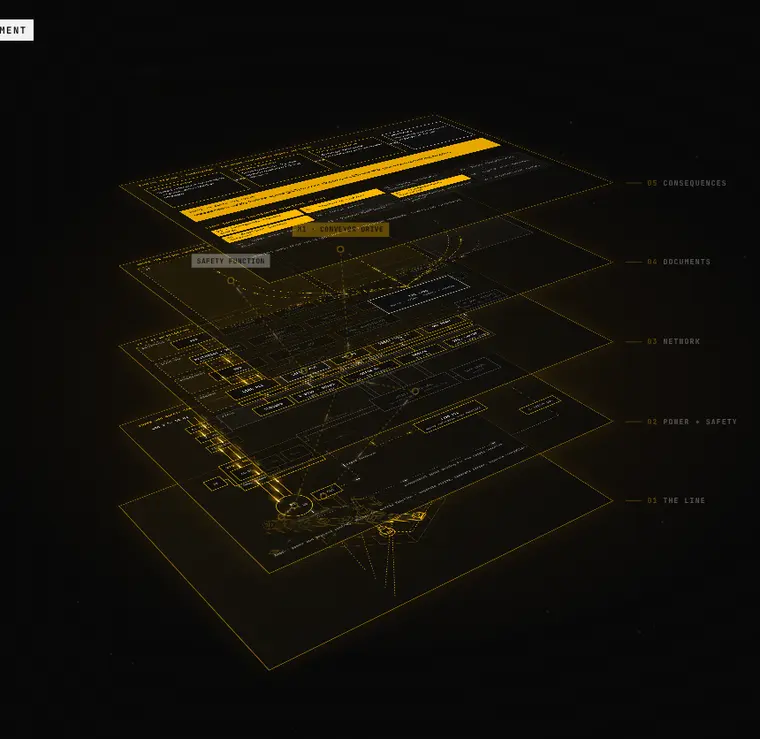
A digital failure shouldn't become an uncontrolled physical consequence.
What stops a wrong command from becoming a wrong movement?
A conveyor drive, running. Scroll through the machine, its circuits, its network, its documents — and how it fails.
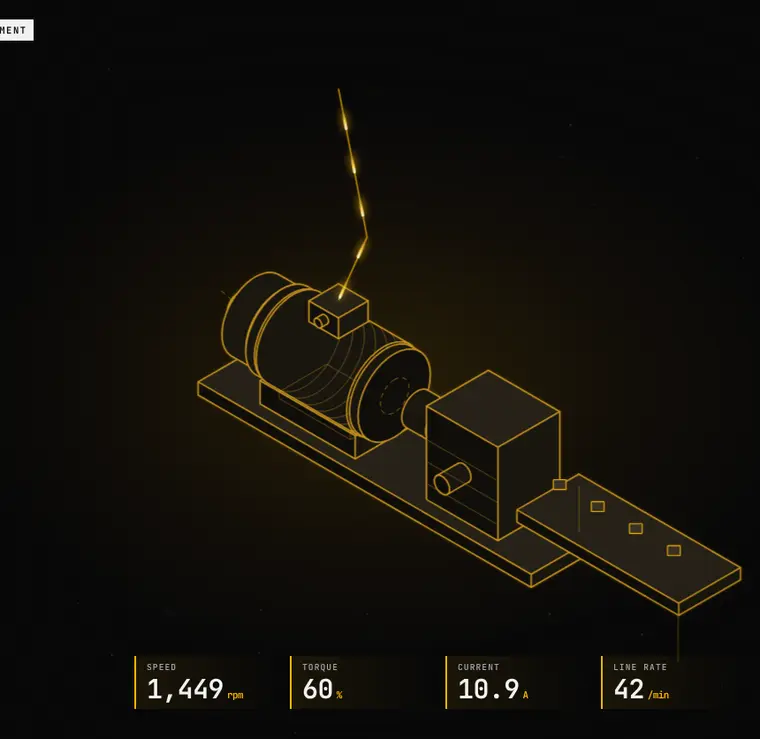
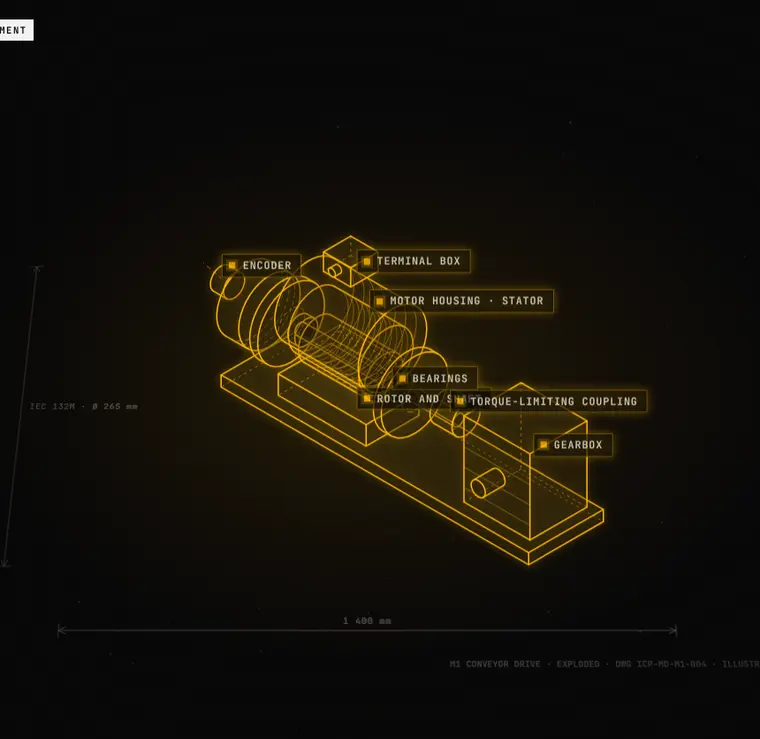
Motion is physical parts and one digital instruction.
Rotor, bearings, coupling and gearbox turn a speed reference into force on the line. Select a part to see what it depends on and what limits it.
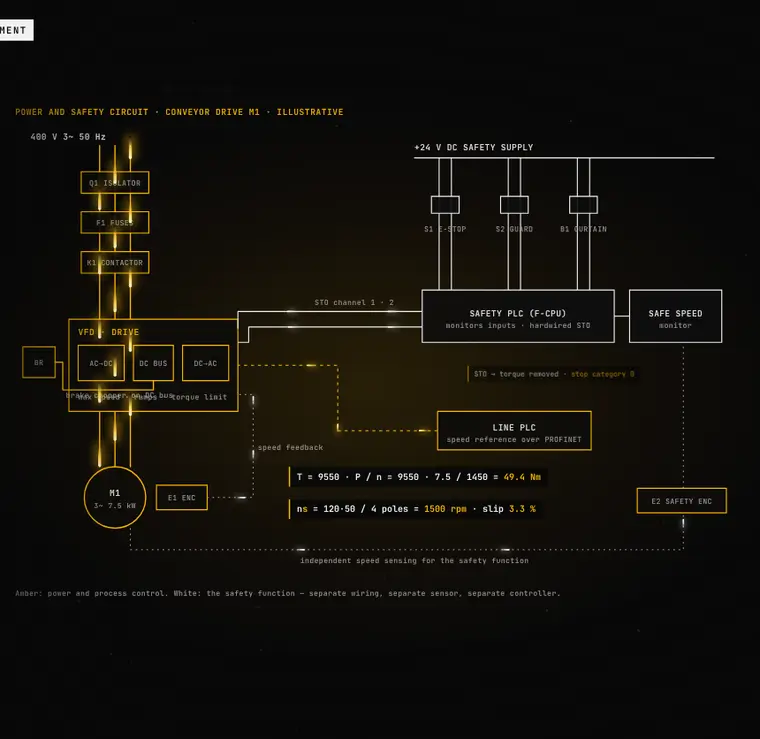
Two circuits. Only one is relied on to stop it safely.
Power flows through the isolator, contactor and drive to the motor. The safety function runs on separate wiring: e-stop, guard and light curtain into a safety PLC that removes torque through hardwired Safe Torque Off — with its own speed sensor.
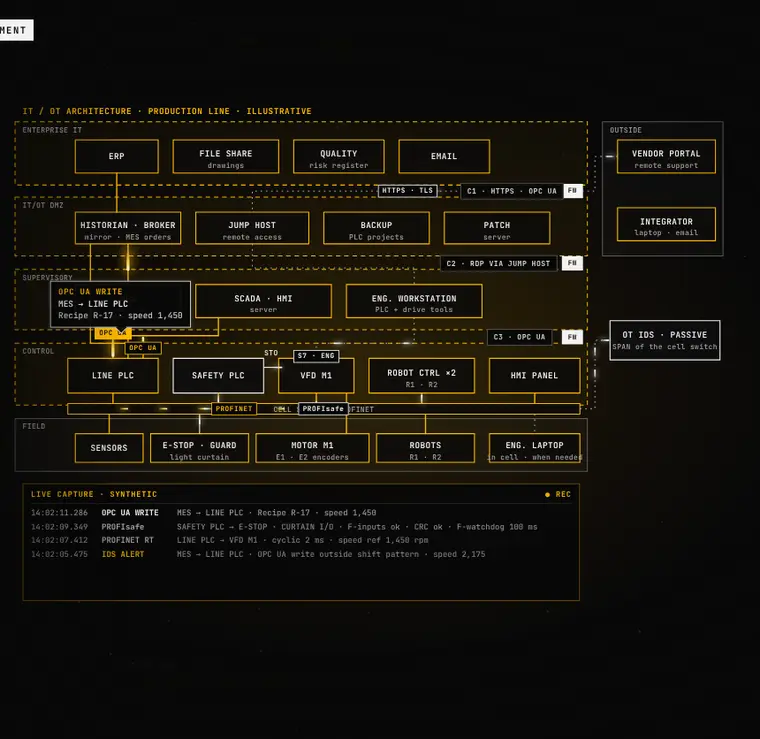
The speed reference comes from somewhere else.
Orders flow from ERP to MES to the line PLC. The PLC talks to the drive every few milliseconds. Engineers and vendors reach in through a jump host. Every path is legitimate — and every path can carry the wrong instruction.
A PASSIVE OT IDS WATCHES A COPY OF THE CELL TRAFFIC AND FLAGS WRITES THAT SHOULD NOT HAPPEN.
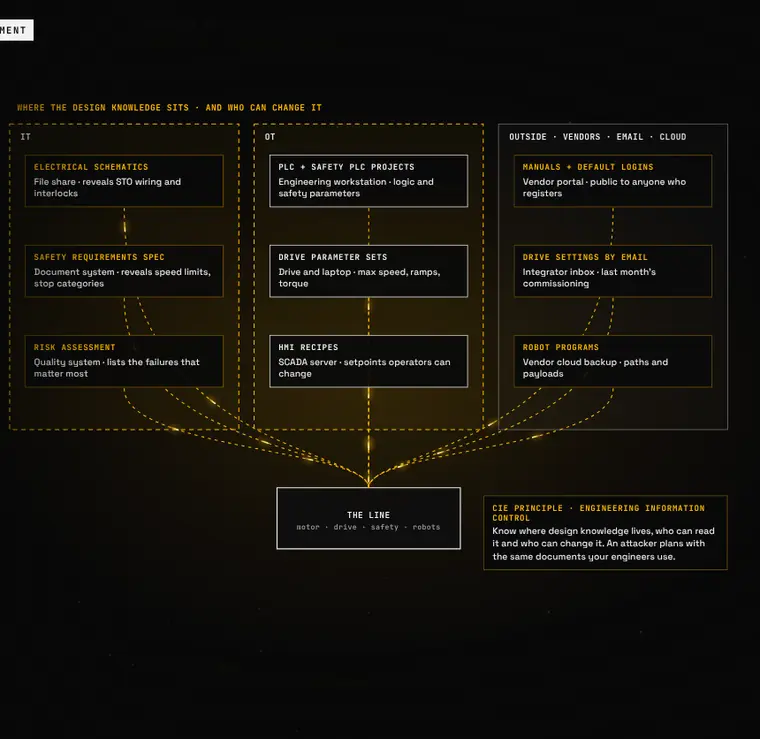
Your design knowledge lives in nine places.
Schematics on the IT file share. Safety parameters on the engineering workstation. Drive settings in an integrator’s inbox. Manuals with default logins on a vendor portal. Each describes how the line could be made to fail.
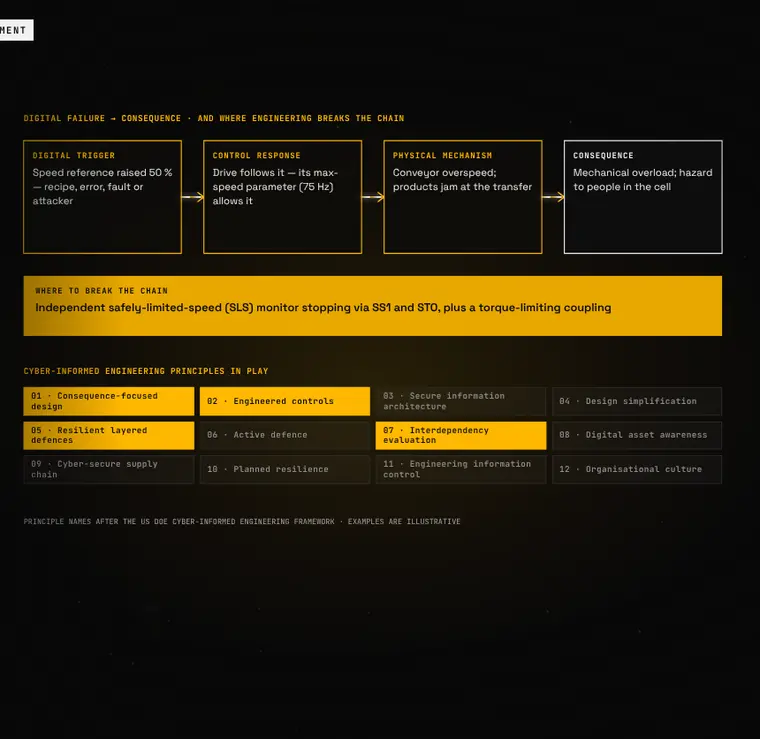
Start from the consequence, not the attacker.
Cyber-informed engineering asks what the machine could be made to do, then designs so that digital failure cannot reach the worst outcome. Pick a digital failure.
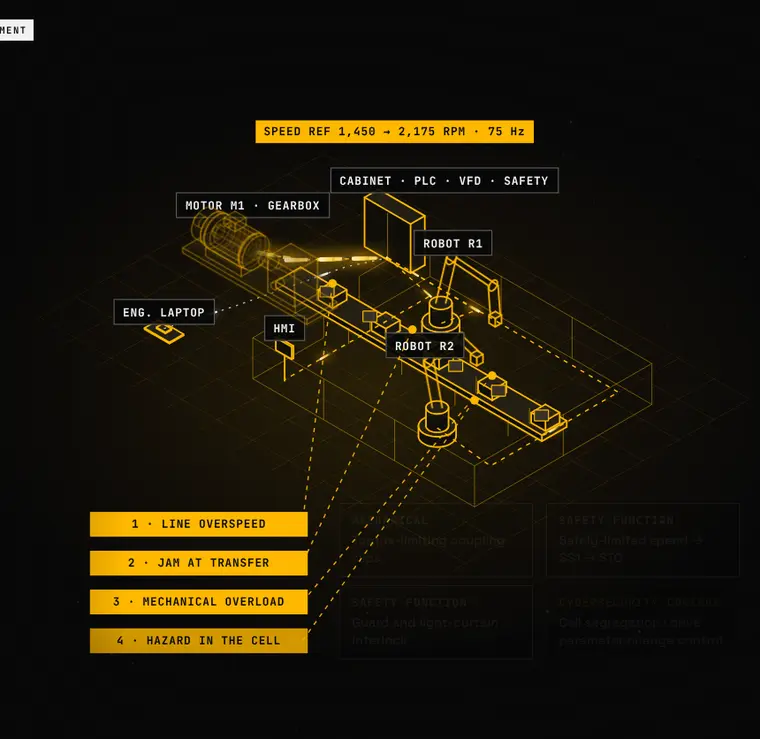
Put limits where they act — and keep them independent.
Drive speed limits sit on the same path as the command. A safely-limited-speed monitor stopping through SS1 and STO, a slipping coupling and a guarded cell do not. Toggle the safeguards.
We help you do cyber-informed engineering.
Five views of one line — the machine, its circuits, its network, its documents and its consequences. ICP brings them together, traces each digital failure to its physical outcome and checks that every safeguard really limits it. An ICP engineer signs every finding.
- What digital condition are we testing?
- What could operations experience?
- Where could resilience sit?